
India's trade with West Asia saw a significant decline of over 28% in April, marking the second consecutive month of contraction. This downturn is attributed to severe shipping disruptions stemming from the ongoing conflict involving the US, Israel, and Iran, particularly impacting the crucial Strait of Hormuz waterway.

A prolonged supply shock can transmit to lower incomes, and dampen confidence and sentiment, warns Aditi Nayar, chief economist, head-research and outreach, ICRA.
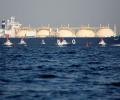
Iranian Deputy Foreign Minister Kazem Gharibabadi has urged India to take the lead in bringing peace to West Asia, highlighting the UAE's role in stalling BRICS consensus on the conflict. Gharibabadi also discussed a new framework with Oman for merchant vessels passing through the Strait of Hormuz.
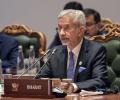
India has expressed serious concerns about the West Asia crisis and its potential impact on energy supplies and maritime stability, urging BRICS nations to find practical solutions to geopolitical challenges and unilateral sanctions.

Even if there is an early agreement on a cessation of hostilities in West Asia, the price shock will not go away easily, points out A K Bhattacharya.

The escalating crisis in West Asia and its impact on the global energy supply chain are expected to dominate deliberations at a two-day meeting of BRICS foreign ministers to be hosted by India.
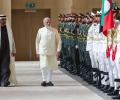
Prime Minister Narendra Modi has offered India's support to bring peace to West Asia during talks with UAE President Sheikh Mohamed bin Zayed Al Nahyan. Both countries signed agreements to strengthen strategic collaborations in energy and defence.

Bangladesh's deposed Prime Minister Sheikh Hasina congratulated Suvendu Adhikari on assuming office as West Bengal's Chief Minister after the BJP's victory in the state.

The extent of doubts over the fairness of this election can be assessed by juxtaposing two figures: Total votes polled by the two principal parties and the number of people who were disallowed from voting this time, observes Nilanjan Mukhopadhyay.

India's pharmaceutical industry is experiencing increased bulk drug prices, particularly for APIs from China, following the escalation of the West Asia crisis in March. While current inventories provide a temporary buffer, concerns are mounting over the availability of key solvents and feedstocks, potentially leading to manufacturing disruptions and shortages in specific drug categories.
The West Bengal government, led by Chief Minister Suvendu Adhikari, has announced the implementation of several key administrative and policy measures, including the adoption of the Ayushman Bharat health scheme, land transfer to the BSF for border fencing, and the implementation of the BNS criminal law.

Indian refiners are recalibrating their crude sourcing strategy due to supply disruptions in West Asia, leading to Venezuela and Brazil emerging as top five suppliers in April, replacing traditional sources like Iraq and the United States.

In West Bengal's political circles, it was widely believed that after Mamata Banerjee, Suvendu Adhikhari was perhaps the only leader with a truly significant mass base of his own.
West Bengal's new government, led by Chief Minister Suvendu Adhikari, has approved several key policy changes, including the implementation of the Ayushman Bharat health scheme, land transfer for border fencing, and the adoption of new criminal laws.

Madhya Pradesh Chief Minister Mohan Yadav has expressed confidence that the BJP will form a government in West Bengal, praising Prime Minister Narendra Modi's leadership and citing high voter turnout as a sign of public trust.

If West Bengal does not begin to reclaim its lost pride, the state would have lost -- perhaps irreversibly, this time, notes Vice Admiral Biswajit Dasgupta (retd).
India's fiscal deficit is projected to reach 4.5 per cent of GDP for the current fiscal year, exceeding the budgeted target, as the government's policy responses to the West Asia conflict are expected to strain public finances, according to research firm BMI.
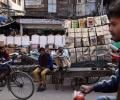
Moody's Ratings has downgraded India's growth forecast for financial year 2026-27 (FY27) to 6 per cent from 6.8 per cent, attributing the revision to weaker consumption and industrial activity, elevated energy prices, and rising input costs stemming from the West Asia conflict.
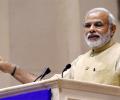
Prime Minister Narendra Modi expressed confidence that the BJP would form the next government in West Bengal after the assembly polls, asserting that he would return to the state for the oath-taking ceremony after results are announced on May 4.

Polling for West Bengal's remaining 142 assembly seats will be held in the second phase on Wednesday, April 29, 2026.

Russia's First Deputy Prime Minister Denis Manturov met with Indian leaders to discuss strengthening bilateral ties in key sectors amidst the escalating conflict in West Asia.

Suvendu Adhikari was sworn in as the first BJP chief minister of West Bengal, marking the end of the Trinamool Congress' 15-year rule in the state.

Indian stock markets experienced a significant sell-off, with the Sensex tumbling over 1,300 points, driven by escalating crude oil prices due to US-Iran tensions and Prime Minister Narendra Modi's call for austerity measures, which amplified investor concerns about India's economic outlook.

The Enforcement Directorate (ED) conducted raids at multiple locations in West Bengal as part of a money laundering investigation into an alleged Public Distribution System (PDS) scam.

India's exports experienced their steepest fall in five months, declining by 7.44 per cent in March to $38.92 billion, primarily due to trade uncertainty and geopolitical tensions, with shipments to West Asia contracting by over 50 per cent.

The polling for the Tamil Nadu Elections will take place on Thursday, April 23, 2026. Out of the 294 assembly seats, 152 seats in West Bengal will go to polls in the first phase on Thursday.

The TMC and BJP are clashing over Bengal's food culture, with allegations of potential dietary restrictions adding spice to the West Bengal election campaign.

Indian equity benchmark indices, Sensex and Nifty, tumbled nearly 2 per cent for the fourth consecutive session, driven by elevated crude oil prices, escalating US-Iran tensions, unabated foreign fund outflows, and a depreciating rupee.
Indian equity benchmark indices, Sensex and Nifty, tumbled nearly 2 per cent for the fourth consecutive session, driven by elevated crude oil prices, escalating US-Iran tensions, unabated foreign fund outflows, and a depreciating rupee.

India is the only significant power that all parties trust, or at least do not distrust, notes former defence secretary Ajay Kumar.

Several incidents of post-poll violence have been reported across West Bengal, with tension escalating in various districts following the recent assembly elections. Clashes between political party supporters have led to injuries, arrests, and heightened security measures.
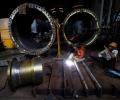
India's industrial production growth decelerated to a five-month low of 4.1 per cent in March, primarily due to the subdued performance of the manufacturing and power sectors, exacerbated by the West Asia crisis.

Defending champions West Bengal began strongly in the Senior National Rugby Sevens Championship, securing decisive victories. Haryana also impressed, while Maharashtra recorded a massive win. The tournament progresses to the knockout stage.

The Ministry of External Affairs (MEA) has stated that Prime Minister Narendra Modi and External Affairs Minister S Jaishankar are actively engaged with world leaders to promote dialogue and diplomacy for peace in West Asia, while also ensuring the safety and well-being of the Indian community in the region.

The first phase of the West Bengal assembly elections saw a high voter turnout across 152 constituencies, with nearly 90 per cent of electors participating till 5 pm. Polling was conducted amid tight security, with reports of clashes and intimidation in some areas.

India's foreign secretary Vikram Misri on Thursday participated in a high-level meeting hosted by the United Kingdom on the evolving situation in West Asia, underlining concerns over maritime security, energy supply disruptions and the need for diplomatic de-escalation.

Amidst global energy market volatility driven by the West Asia crisis, Russia has proposed increasing its crude oil and natural gas supplies to India, strengthening bilateral energy ties and aiming for USD 100 billion in annual trade by 2030.
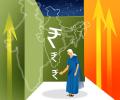
The World Bank has affirmed India's strong position to withstand the current global energy shock, citing high foreign exchange reserves, fiscal space, and low inflation as key buffers supporting continued growth despite international headwinds.

Despite geopolitical tensions and FII outflows, Indian small and midcap stocks have not only recovered losses but are also outperforming largecap indices, driven by attractive valuations, domestic institutional support, and a rebound in earnings.
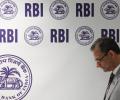
Uncertainties stemming from the West Asia crisis and its potential impact on inflation and economic growth were key factors in the Reserve Bank of India's Monetary Policy Committee (MPC) decision to maintain the status quo on interest rates, according to the recently released MPC meeting minutes.
 © 2026 Rediff.com - Advertise with us - Disclaimer - Privacy Policy - Sitemap - Feedback - About us - Terms of use - Grievances